Who Makes the Cut: The Quiet Politics of the Family Holiday Card
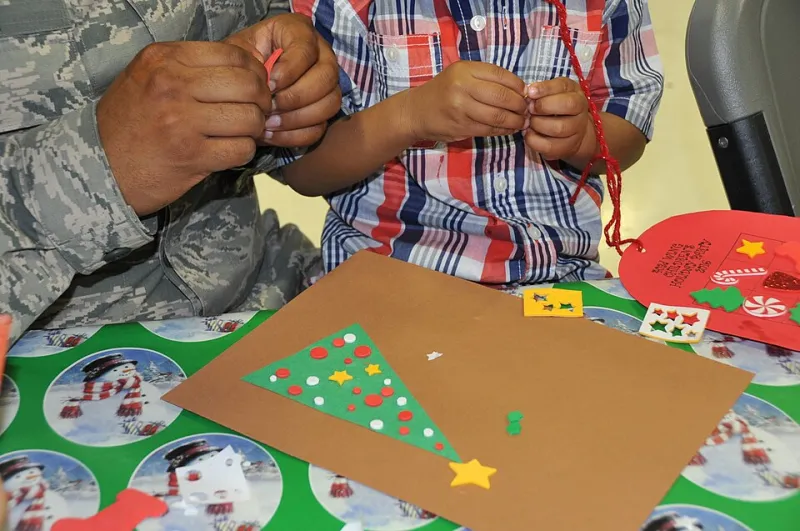
Photo: Master Sgt. Jessica Kendziorek, Public domain, via Wikimedia Commons
Every December, somewhere in America, a group chat goes silent because someone asked for a better photo.
It sounds like nothing. It is never nothing. The holiday card is the one piece of mail most households still open on purpose, and it carries a job no one assigned it: once a year, in glossy 5x7, it declares who your family is. Then it gets taped to a stranger's refrigerator in Ohio, and the declaration becomes public.
Fifteen shots, one frame
Most people describe the same process. Somebody opens a photo site, uploads a batch that spans three seasons and two hairstyles, and begins the slow work of elimination. This one has your ex in the background. This one has the toddler screaming. This one is lovely, but it's from August, and August is a lie about December.
Curation is not the scandal here. Curation is the whole point. The question worth asking is who never made it into the batch at all.
The arithmetic of a blended family
If your household includes stepkids, half-siblings, a new partner, a custody calendar, or a set of grandparents who won't be in the same room as another set of grandparents, then the card is less a greeting than a diplomatic instrument.
One mom in Columbus described photographing her kids on a Tuesday, because that was the custody night, and then wrestling with whether to say so in the caption. "I didn't want the card to imply a week I don't have," she said. "So I wrote 'so grateful for every minute.' Which is true. And also a small apology nobody asked for."
There's a version of this where the card becomes a claim: look how whole we are. There's a better version where it becomes an honest snapshot: this is who was here.
The relative who isn't in the picture
The harder edits rarely get discussed at the printer. A brother you haven't spoken to since the spring. A parent whose politics ended Thanksgiving early. A cousin who moved away and stopped answering texts. Do you leave the gap where they were, or quietly reframe so nobody notices there was ever a gap?
The passive-aggressive captions are legendary — the missed you! aimed at exactly one person, the group shot with an intentional sliver of empty couch. But most people don't want a fight. They want to get through the holiday without explaining their family to their neighbor's fridge.
What's worth naming is this: leaving someone out of a card doesn't make the relationship disappear, and including them doesn't heal it. The photo is not the relationship. It's a caption on a relationship, and captions can be edited next year.
The pressure to look like a tableau
Social media has raised the stakes considerably. A card used to go to forty households. Now the same image goes to every person you've ever met, next to a thousand other families in matching flannel, in golden-hour light, in a field they drove to.
So the average card gets retouched, color-corrected, and staged. Which makes the aging relatives problem sharper. A grandmother who doesn't want to be photographed because she doesn't recognize her own neck. A father in chemo who will pose but only from the left. A family deciding, together, whether this is a card that ought to include the oxygen tank.
"She said, 'Don't make this the year I look sick,'" one woman remembered. "And I said, 'Then we won't use that one.' And then that was the last Christmas she had, and I have exactly one picture of her from it, and I'm glad somebody took it."
What the awkward shot actually documents
The truth is that the polished photo is the least interesting thing in the envelope. The one that usually gets remembered is the toddler mid-meltdown, the dog photobombing, the uncle in the corner of the frame who didn't know he was in it. The photo where the family looks like a family and not a brand campaign.
Some people now deliberately include the empty chair. The set of grandparents who died this year, named in the caption. The sibling who's stationed overseas, cropped in as a bad headshot with a heart around it. The foster kid who was only there for four months and is still family.
That's a card that belongs to the actual household, not to the expectation of one.
Send the one that's true
So here's a small December argument: crop less. Explain more. Let the caption carry the complication the picture can't. And if someone isn't in the frame this year, let that be a fact about the year and not a verdict about the person.
A family card is a sentence, not a census. You get to write a new one next December.
Every face holds a story worth telling — including the ones standing just outside the frame, waiting to be asked in.