The Morning the Mirror Got Strange: On Aging, Identity, and the Face You No Longer Quite Recognize
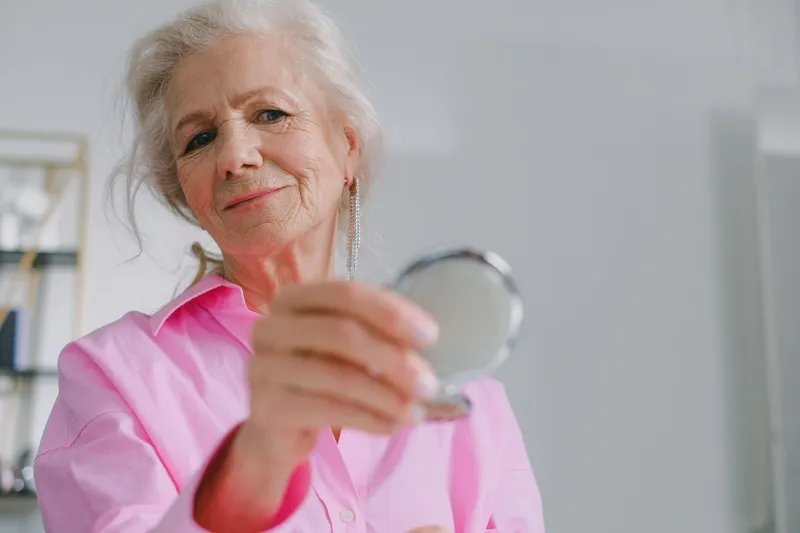
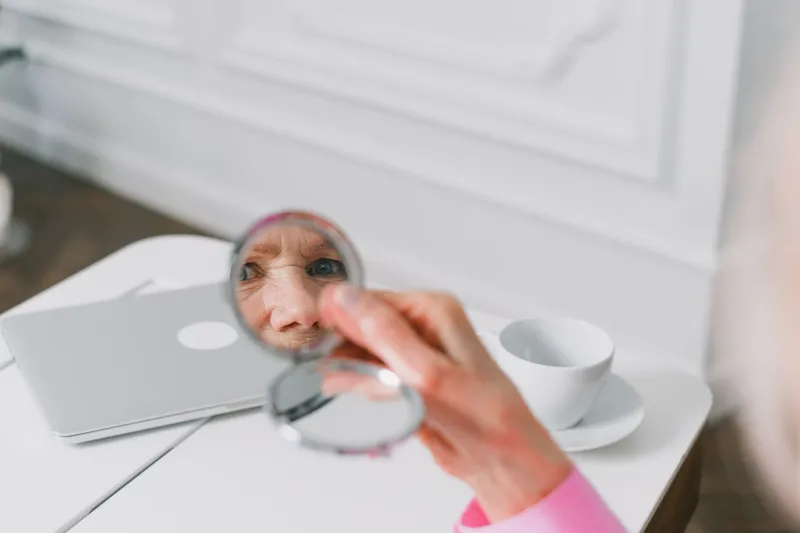
Diana was 47 when it happened. She was standing in the bathroom of her home in Columbus, Ohio, getting ready for a work meeting, when she caught her reflection at an angle she'd never quite caught before. The overhead light. The particular tilt of her chin. Something.
"I genuinely didn't recognize myself for a second," she says. "Not in a dramatic way. Just — there was a pause. Like my brain had to do a little extra work to confirm that was me."
She stood there for a moment, then got on with her morning. But she hasn't quite stopped thinking about it since.
It Doesn't Arrive the Way You Expect
We talk about aging like it's a slow tide — something that creeps in so gradually you barely notice until it's already happened. But for a lot of people, the experience is less gradual and more punctuated. A photo surfaces from a family gathering and you see something in your own face you weren't prepared for. You glance in a shop window and do a double-take. The light in a new city does something to your reflection that your bathroom mirror at home never does.
These aren't dramatic moments. They don't make the news. But they're the moments where something quietly fundamental shifts — where the face you've been carrying through your life starts to feel like it's telling a story you haven't fully caught up to yet.
This isn't a beauty piece. This isn't about anti-aging serums or the pressure to look younger (though that pressure is very real, and very American). This is about the stranger experience underneath all of that: the quiet identity crisis that can come when your reflection stops matching your internal sense of self.
The Gap Between Inside and Outside
Psychologists have a term for the internal image we carry of ourselves: the subjective age — the age we feel, as opposed to the age we are. Research consistently shows that most adults feel younger than their chronological age, often by a decade or more. Which means there's a built-in gap, for most of us, between the self we inhabit and the face we present to the world.
For a while, that gap is easy to ignore. Then, at some point, it isn't.
"There's often a moment — and it happens at different ages for different people — where that gap becomes visible," says Dr. James Whitfield, a clinical psychologist in Seattle who works with clients navigating major life transitions. "And for some people, that visibility is genuinely disorienting. It's not vanity. It's identity."
The distinction matters. When we talk about people struggling with aging and their appearance, we tend to collapse it into vanity — the assumption that what they're really upset about is looking less attractive by some cultural standard. But Dr. Whitfield pushes back on that.
"For many people, the face is how they recognize themselves," he says. "It's continuity. When it changes significantly, it can feel like a kind of loss — even if you can't fully articulate what was lost."
The Stories People Carry
Rodrigo, 55, grew up in a Cuban-American household in Miami where he says he was always told he looked just like his father. "Same jaw, same eyes, same everything. It was a source of pride. I carried my dad's face."
When his father died three years ago, Rodrigo found himself looking in the mirror differently. "I started looking for him," he says quietly. "And I found him. But I also started seeing things I hadn't noticed before — the lines, the gray, the way my eyes are starting to look the way his did near the end. It's beautiful and it's hard, all at once."
For Rodrigo, the aging face isn't just about time. It's about lineage, grief, and the strange intimacy of watching yourself become someone you loved.
For Priya, 38, a software engineer in the Bay Area, the experience arrived earlier than she expected. A chronic illness in her early thirties left visible marks — fatigue that settled into her face in ways that went beyond just tiredness. "I looked older than I was, and I looked sick even when I wasn't," she says. "It forced me to confront questions about identity and appearance that most people don't hit until much later."
What she found, eventually, was something she didn't expect: a kind of hard-won acceptance. "My face tells the truth about what I've been through. That's not nothing. That's actually something."
Time Made Visible
There's a philosophical thread here that doesn't get enough attention. Our faces are, in a very literal sense, time made visible. Every line is a record. Every shift in texture or contour is the physical residue of experience — sun, laughter, grief, sleep deprivation, decades of raising an eyebrow at the news.
In many cultures, that's not something to mourn. It's something to read.
But in America, we've built an entire industry — worth billions — around the premise that visible aging is a problem to be solved. And when the dominant cultural message is that your changing face is something to fight, it becomes harder to simply meet that face with curiosity instead of alarm.
"I think what I'm really working through," Diana says, "is that I thought I had more time. Not more time to live — I'm not being dramatic. More time before this part. Before my face started looking like someone in the next chapter."
She laughs a little. "I'm not sure I was ready for the next chapter."
What It Means to Stay Present in a Changing Face
Dr. Whitfield talks about what he calls reflective integration — the ongoing, sometimes uncomfortable work of updating our self-concept to match our lived reality. It's not about making peace with aging in some tidy, resolved way. It's about staying in relationship with your own face rather than turning away from it.
That might mean sitting with the discomfort of a new photograph instead of immediately deleting it. It might mean noticing what you feel when you look in the mirror and getting curious about it rather than dismissive. It might mean, as Priya found, reframing what a changed face is actually saying.
Every face on this site holds a story. And part of that story — for all of us, eventually — is the story of becoming someone we didn't fully anticipate. Of watching time move through us and leave its mark.
The mirror isn't wrong. It's just showing us something we're still learning how to see.