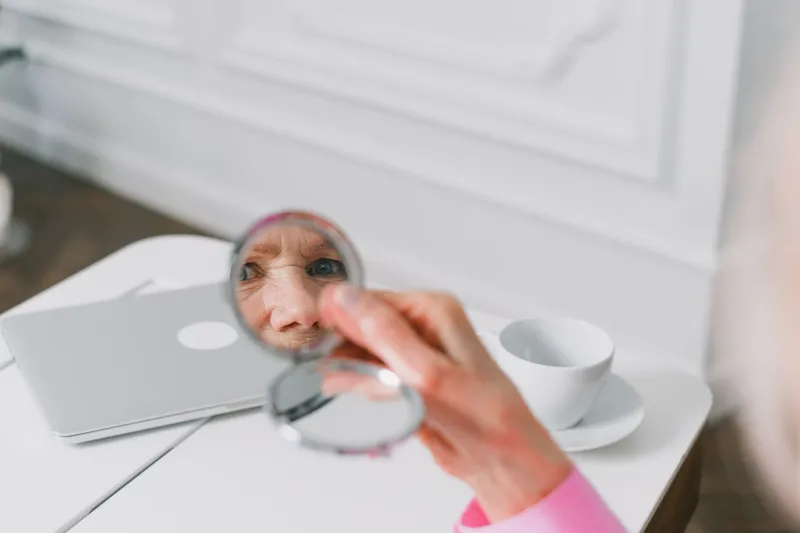
The Face in the Rearview: When Life Moves So Fast Your Reflection Can't Keep Up

Photo: Sofina Rise, CC BY-SA 4.0, via Wikimedia Commons
Somewhere around week six of new parenthood, Denise stopped recognizing herself in photographs.
It wasn't dramatic. Nobody told her she looked different. But when her sister texted a candid from a Sunday afternoon at the park — Denise sitting cross-legged on a blanket, her daughter asleep against her chest, her expression somewhere between exhausted and undone — she stared at the image for a long time.
"That woman looked like someone who had already been through something," she says. "And I guess she had. I guess I had. But I hadn't caught up to it yet."
This is a story a lot of Americans know but rarely talk about directly: the strange, disorienting lag between who you're becoming and who you still think you are. The body keeps the score, as they say. But sometimes the face keeps it first.
The Mirror Doesn't Wait
We tend to think of transformation as something that happens inside — a slow interior reckoning that eventually makes its way to the surface. But for many people navigating sudden life upheaval, it works the other way around. The face shifts first. The identity catches up later, if it catches up at all.
After a year of chemotherapy for breast cancer at 38, Priya had watched her hair disappear, her weight fluctuate, and her skin change in ways she hadn't anticipated. What surprised her most wasn't any single physical change — it was the cumulative effect of looking in the mirror and seeing a face she couldn't quite claim.
"I kept expecting to feel like myself again once treatment ended," she says. "But the face that came back wasn't the same face that went in. And I hadn't grieved the old one yet because I was too busy surviving."
The psychological term for this gap is identity disruption — a period of misalignment between how we look, how we feel, and how we understand ourselves. It's well-documented in clinical literature around illness and recovery. But it shows up in far more ordinary transitions too: a major weight change, a divorce, aging into a new decade, moving away from the community that shaped you.
When the Change Is Supposed to Be Happy
One of the trickiest versions of this disorientation is the kind that comes wrapped in joy — or at least in what everyone around you insists should be joy.
New parents are particularly vulnerable. The cultural script around parenthood is so relentlessly positive that the experience of looking in the mirror and seeing a stranger — a tired, changed, somehow older stranger — can feel like a personal failure rather than a universal human experience.
"Everyone kept telling me I was glowing," says Denise. "And I thought, glowing with what? Because I looked at myself and saw someone I didn't know yet. Someone I was going to have to introduce myself to."
Jordan, a 41-year-old who left a fifteen-year career in finance to become a high school art teacher in rural Vermont, describes a similar uncoupling. "I lost weight from the stress of the transition. My face got sharper. And I kept running into people I used to know and seeing this flicker in their eyes — like they were recalibrating me. It made me realize I was recalibrating myself too. Just on a delay."
The external world often processes our transformations faster than we do. People react to the new face before we've fully inhabited it. And that reaction — the double-take, the "you look so different," the unsolicited commentary — can accelerate the disorientation rather than ease it.
What the Lag Feels Like From the Inside
Descriptions of this experience tend to cluster around a specific vocabulary: floating, watching from outside, playing a role, not quite landed. People talk about catching their reflection in shop windows and doing a double-take. About looking at photos from six months ago and feeling like they're looking at someone else's life.
For some, it's accompanied by grief — even when the change is objectively positive. The face you used to have was the face you knew how to live in. The new one requires a kind of reacquaintance that nobody really prepares you for.
For others, the lag is more neutral — a kind of curious witnessing. "I felt like I was watching myself become someone," says Priya. "Like I was a character in a story and I didn't know yet how it was going to turn out."
Psychologists who work with clients through major life transitions often note that this phase — the liminal space between the old face and the new self — is actually one of the most generative periods in a person's development. The discomfort of not quite recognizing yourself is, paradoxically, the discomfort of growth.
"The people who move through it most gracefully," says one therapist who works with cancer survivors and career changers, "are the ones who can hold the question without rushing to answer it. Who can look at the changed face and say, 'I don't know you yet, but I'm paying attention.'"
Learning to Catch Up
Denise's daughter is three now. She's framed the park photo and hung it in the hallway.
"I look at it differently now," she says. "I can see what was happening to me — what was being asked of me — and I have a lot of tenderness for that woman. She didn't know what she was doing. She was just becoming."
That tenderness — for the face in the rearview, for the self that changed before it had a chance to understand why — might be the most important thing transformation teaches us. The mirror doesn't wait. But the story doesn't have to be finished to be worth telling.
Every face holds a story. Sometimes you have to live it before you can read it.