The Stranger in the Screenshot: What Happens When You Finally See Your Own Face
It usually starts with a video.
Maybe someone recorded you at a family gathering and you watched it back. Maybe you got tagged in a candid at a work event. Maybe you were on a Zoom call and you accidentally looked at your own tile instead of the speaker, and for one unguarded second, you saw yourself the way everyone else does — mid-sentence, unrehearsed, entirely unmanaged.
And something in you went: wait, is that what I look like?
For most people, the answer is yes. And the follow-up question — why does that feel so strange? — turns out to have a genuinely fascinating answer.
The Mirror Has Always Been Lying to You
Here's the thing about the mirror: it's not showing you your face. It's showing you a reversed version of it, a reflection that flips your left and right, presenting you with a face that literally no one else sees. Over years of daily use, your brain locks onto that flipped image as the definitive version of you. It becomes the reference point.
So when you see a photograph — which shows you the way the rest of the world sees you — something feels off. The part you've always thought of as your "good side" is now on the wrong side. The way your smile curves, the subtle asymmetry of your features, the angle of your nose — it's all technically accurate, but it reads as wrong.
This is called the mere exposure effect, and it's well-documented in psychology. We prefer the faces we've seen most often. For ourselves, that's the mirror version. For everyone else, it's the photograph version. You are, in a very literal sense, the only person in your life who sees your face backwards.
"People are often more critical of photographs of themselves than they would be if they were looking at a stranger with the same features," says Dr. Camille Torres, a cognitive psychologist at the University of Michigan. "The image feels wrong because it doesn't match the mental model. But the mental model is the one that's distorted, not the photo."
The Selfie Didn't Solve This — It Made It Weirder
You might think the selfie era would have fixed this disconnect. We're taking more photos of ourselves than at any previous point in human history. Surely by now we've gotten comfortable with our own image?
Not exactly.
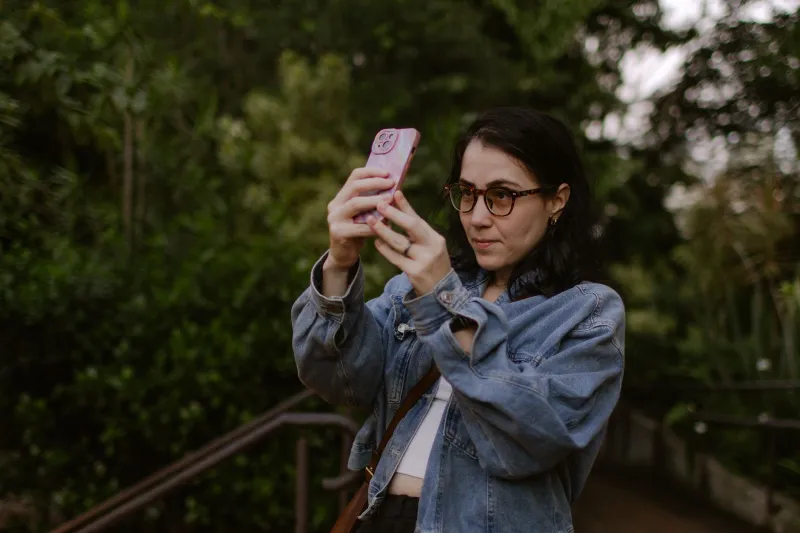
The selfie introduced a new layer of distortion: the front-facing camera. Most smartphone cameras, when held at arm's length, create a slight fisheye effect that exaggerates the size of whatever is closest to the lens — usually your nose, your forehead, or your chin. A 2018 study from Rutgers found that selfies taken at arm's length can make a nose appear up to 30 percent larger than it actually is.
So now we have two inaccurate reference points — the flipped mirror and the distorted selfie — competing to define what we look like. And then we filter both of them, smooth them, adjust the lighting, and post the most curated version of either.
What we almost never see is just... our face. As it actually is. Moving through the world.
The Candid Confrontation
When it does happen — when an unmanaged image of yourself surfaces — the reaction is rarely neutral.
Tamara Singh, 38, a high school teacher in Houston, describes seeing footage of herself teaching for the first time as part of a professional development review. "I'd been teaching for ten years. I had a very specific image of myself in front of a classroom — authoritative, expressive, engaged. And then I watched the video and I was like... who is this person?"
She laughs now, but says the experience was genuinely disorienting. "I moved differently than I thought I did. My face made expressions I had no idea I was making. I didn't recognize my own mannerisms. It took me a few days to sit with it."
What Tamara describes is sometimes called the "video self-confrontation" effect — a well-studied phenomenon in which seeing yourself on video triggers a more critical and emotionally charged self-assessment than looking in a mirror does. The movement, the voice, the unguarded moments between conscious expressions — it all adds up to something that feels uncomfortably authentic.
But here's the thing: for many people, the discomfort eventually gives way to something else.
"After I got over the initial weirdness, I actually started to like what I saw," Tamara says. "I was more animated than I thought. More present. I just hadn't been able to see it before because I was too busy trying to look right."
Technology, Recognition, and the New Self-Encounter
Facial recognition technology, whatever its considerable ethical complications, has created a new category of self-encounter that previous generations never navigated. Photo apps that surface memories. Platforms that tag you in images you didn't know existed. AI tools that can age your face, reverse it, or show you what you might look like to someone else.
For some users, these tools have become unexpected windows into self-perception. Marcus Chen, 29, a graphic designer in San Francisco, used an app that showed him a non-mirrored version of his face for the first time. "It was like meeting a relative I'd never seen," he says. "Like, obviously it was me. But it also wasn't the me I knew."
He spent a long time just looking at it. "I think I'd been carrying a pretty harsh internal image of my face for years. Like a vague sense that something was off or asymmetrical in a bad way. And when I saw the actual unflipped version, I was like — no, that's fine. That's actually fine."
What Seeing Yourself Clearly Actually Changes
The psychological literature on self-perception suggests that accuracy matters — not just for vanity, but for how we move through the world. People with more realistic self-images tend to be less anxious in social situations, less preoccupied with how they're being perceived, and more capable of genuine connection.
Which makes sense, when you think about it. If you're operating from a distorted internal image, you're constantly managing a gap between what you think you look like and what you're afraid you might look like. That's a lot of cognitive overhead to carry into a conversation.
Dr. Torres puts it plainly: "Accurate self-perception is a form of self-knowledge. And self-knowledge, generally speaking, is stabilizing."
For Tamara, the classroom video became something she returns to when she's doubting herself. "I watch it when I feel like I'm not connecting with my students," she says. "Because it shows me that I actually am. My face shows it, even when I can't feel it from the inside."
There's something quietly radical about that — using your own face as evidence of your own worth. Trusting the image, for once, over the internal story.
Every face holds a story. Sometimes the hardest part is being willing to actually read it.