Holding the Tongue Their Grandparents Were Told to Lose
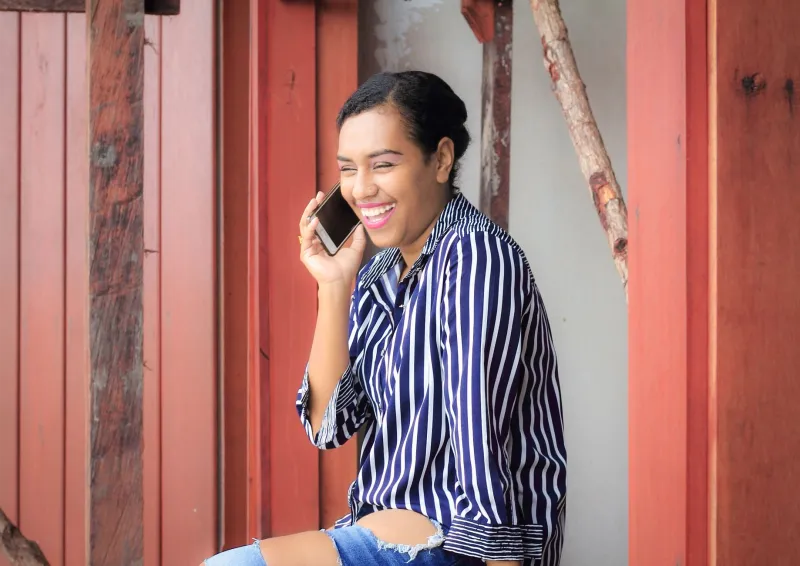
Maria Esperanza Reyes-Whitfield grew up watching her grandmother press her lips together whenever she answered the phone. "She'd go completely flat," Maria says. "Like she was ironing herself out before anyone could hear the wrinkles." Her grandmother, who came to California from Oaxaca in the late 1970s, had spent decades carefully sanding down the edges of her Spanish-inflected English — dropping the rolled R's, softening the vowels, learning to sound like someone who belonged here without question.
Maria, who was born in Fresno and has never left the country, still talks like her grandmother used to in private. The lilt is there. The rhythm that stretches certain syllables just a beat longer than standard American English allows. She didn't pick it up by accident. She kept it on purpose.
"People ask me where I'm from," she says. "I tell them I'm from here. Then they ask where I'm really from. And I think — yeah, exactly. That's exactly why I sound like this."
The Voice as Inheritance
For generations, assimilation in America came with a very specific soundtrack. Immigrant families were told, directly and indirectly, that sounding "too foreign" was a liability. Accent reduction courses were marketed as tools for professional advancement. Children were corrected in classrooms. The message was consistent: the faster you erased the old country from your voice, the faster you'd be accepted into the new one.
But something has shifted. Across the country, a growing number of second and third-generation Americans — people who grew up here, went to school here, have never needed a visa to stand on American soil — are making a deliberate choice to preserve, and in some cases reconstruct, the speech patterns their families were pressured to abandon.
For these individuals, the accent isn't a remnant. It's a reclamation.
Dr. Ananya Krishnamurthy, a sociolinguist at a university in the Pacific Northwest, has been studying what she calls "heritage vocal identity" for the better part of a decade. She's careful to distinguish it from the natural code-switching most bilingual or multicultural Americans do without thinking.
"What we're seeing now is more intentional," she explains. "People are actively choosing not to neutralize. They're making a statement about what they want their voice to represent — and who they're willing to be legible to."
When Fitting In Meant Disappearing
Jeremy Osei-Mensah is a 34-year-old graphic designer living in Atlanta. His parents emigrated from Ghana in the early 1990s. He grew up in a suburb of Columbus, Ohio, where he was often the only Black kid in the room who also had what his classmates called "a weird accent." It wasn't fully Ghanaian — he was American-born — but the cadence of his parents' speech had woven itself into his own.
"I got made fun of for it," he says simply. "Not just by white kids. By other Black kids too. Like I was trying to be something extra. Like being American wasn't enough for me."
By high school, Jeremy had flattened most of it out. By college, it was almost entirely gone. Then, in his late twenties, his father was diagnosed with a serious illness, and Jeremy spent several months making regular trips back to his parents' home.
"I started hearing myself again," he says. "Not the version I'd edited for everyone else. The original version. And I thought — I did that. I erased that. Nobody took it. I gave it away."
He hasn't given it away since.
The Psychology of Vocal Reclamation
There's something deeply intimate about the way we sound. Unlike clothing or hairstyle or even name, a voice is carried inside the body. It vibrates in the chest before it ever reaches another person's ears. Linguists have long understood that accent is one of the most powerful identity markers humans possess — and one of the most socially policed.
Research consistently shows that people with non-standard American accents face real professional and social penalties. They're perceived as less competent, less educated, less trustworthy — regardless of what they're actually saying. The pressure to neutralize is not imaginary. It has economic consequences.
Which makes the choice to hold on all the more pointed.
"It's not naive," says Dr. Krishnamurthy. "Most of the people I've spoken with are fully aware of the trade-offs. They're not pretending the bias doesn't exist. They're deciding that what they lose by erasing themselves is greater than what they gain by fitting in."
For some, that calculation is political. For others, it's personal. For most, it's both.
Sounds That Carry Someone Else's Life
Lena Kowalczyk-Torres is 28 and lives in Chicago, where she works as a nurse. Her maternal grandparents came from Poland in the 1950s. Her paternal grandparents came from Puerto Rico around the same time. She grew up in a household that sounded like a linguistic negotiation, all the time.
Her accent, if you can call it that, is genuinely hard to place. There's a particular softness to her consonants, a slight musicality in the way her sentences rise and fall, that doesn't match any single region or origin. People ask her about it constantly.
"I used to hate that," she admits. "I wanted to just sound normal. Whatever that means." She laughs. "Now I think — this is what my family actually sounds like. This is what we built together. Why would I want to trade that for something generic?"
She pauses. "My babcia — my grandmother — she worked so hard to sound American. She was proud of it. I don't want to erase that pride. But I also don't want to finish what assimilation started. I want to carry all of it."
What Gets Passed Down When Language Stays
There's a version of this story that gets told as nostalgia — the immigrant grandchild clinging to the old ways out of sentiment. But that framing misses what's actually happening. The people making this choice aren't looking backward. They're making an argument about what American identity should be allowed to sound like.
In a country that has spent centuries trying to create a singular, recognizable American voice, these individuals are insisting on something messier and more honest: that American sounds like everywhere, always has, and the attempt to flatten that out has never been about unity. It's been about hierarchy.
Maria Esperanza Reyes-Whitfield puts it plainly. "My grandmother was ashamed of how she sounded," she says. "Not because there was anything wrong with it. Because people made her feel like there was. I don't want to carry that shame forward. I'd rather carry her voice."
She doesn't iron herself out before answering the phone.
The wrinkles, she's decided, are the whole point.