The People Who Built Your Block Before You Got Here
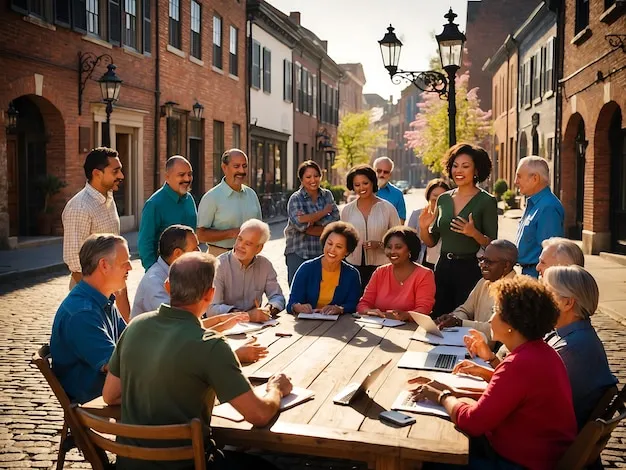
Photo: diverse community members neighborhood meeting urban activism, via img.freepik.com
There's a park bench in Pilsen, Chicago, that nobody has put a plaque on. There's a crosswalk in East Oakland that took eleven years of fighting to get installed. There's a community garden in the South Bronx that used to be a lot full of broken glass and old tires. None of these places have a famous name attached to them. But every single one of them has a face — usually more than one — and those faces belong to people most of us will never read about in a history book.
This is the story of the invisible architects. The ones who shaped American neighborhoods not with money or political power, but with stubbornness, love, and an almost irrational willingness to keep showing up.
The Meeting Nobody Wanted to Attend
Ask anyone who's ever tried to change something at the local level, and they'll tell you the same thing: it starts with a meeting. A badly lit room. Folding chairs. Bad coffee. Maybe twelve people, maybe forty, almost always a mix of exhausted parents, retired teachers, and at least one person who just moved to the neighborhood and doesn't fully understand what they've gotten themselves into.
Dorothy Reyes has been to more of those meetings than she can count. For over two decades, she was the kind of person other people called when something in their Queens neighborhood felt wrong — a landlord ignoring repairs, a bus route getting cut, a developer proposing something that would price half the block out of existence. She didn't hold office. She didn't have a nonprofit. She just answered the phone and showed up.
"People think change happens because someone important decided to care," she says. "But usually it happens because someone unimportant refused to stop caring."
Dorothy's work helped preserve affordable housing units in her corner of Jackson Heights during a period when displacement was gutting similar neighborhoods across the city. She's quick to deflect credit — pointing to neighbors, to a local councilmember who actually listened, to a tenant lawyer who worked pro bono. That deflection is itself part of the pattern. The invisible architects rarely see themselves as architects at all.
Transit, Trust, and the Long Game
In cities across the country, the routes of buses and subway lines weren't just determined by engineers. They were shaped by decades of advocacy from people who understood, viscerally, what it meant to live somewhere without reliable transit.
In Atlanta, community organizers spent years pushing for bus rapid transit along corridors that connected predominantly Black neighborhoods to job centers downtown. Their arguments weren't abstract — they were built from real data about commute times, from testimonials about missing job interviews, from a deep understanding of how geography becomes destiny when you don't have a car.
Marvin Osei was one of those organizers. He spent seven years attending city planning sessions, building coalitions between faith communities and neighborhood associations, and learning enough about transportation policy to argue on technical terms with people who'd been in the field for decades. He wasn't paid for most of that work. He did it alongside a full-time job and a family.
"Transit is a dignity issue," Marvin says. "Where the bus goes tells you who the city thinks matters."
The changes he helped push through didn't happen overnight, and they weren't complete victories. But they moved the needle — and the people who benefit from those routes today have no idea his name is connected to their morning commute. That anonymity doesn't seem to bother him. "The point was never the credit," he says. "The point was the ride."
When a Garden Changes Everything
Public space is political. It always has been. A vacant lot left to rot sends a message. A community garden sends a different one.
In neighborhoods that have been systematically underinvested in — through redlining, through highway construction that cut communities in half, through decades of city budgets that prioritized other zip codes — the reclamation of physical space is an act of resistance as much as it is an act of beauty.
Luisa Mendoza started gardening on a neglected parcel in her North Philadelphia neighborhood almost by accident. She asked the city if she could plant something there. The city said yes, mostly because no one had a better plan for it. That was fifteen years ago. Today, the garden produces vegetables that stock a neighborhood food pantry, hosts after-school programming, and has become the kind of gathering place that urban planners spend millions of dollars trying to manufacture from scratch.
"I just wanted tomatoes," Luisa laughs. But what she built was a commons — a word that's gone out of fashion but describes something people have always needed: a shared place that belongs to everyone and to no one in particular.
The Ripple Effect Nobody Tracks
Here's the thing about local impact: it's almost impossible to measure, which makes it easy to dismiss. There's no metric for the kid who grows up feeling like their neighborhood is worth caring about because they watched adults fight for it. There's no data point for the sense of possibility that comes from seeing a vacant lot turn into something alive.
But those things are real. They shape people. And people shape places. It's a loop that runs quietly underneath all the big official narratives about urban development and city planning.
The faces behind that loop are everywhere, if you know to look. They're at school board meetings and zoning hearings. They're knocking on doors during local elections that most people skip. They're maintaining the little free libraries and organizing the block parties and texting their neighbors when something feels off.
They are, in the truest sense, the people who built your block. Not before you got here, exactly — but certainly before anyone thought to notice.
Seeing the Architects
At Faces of Yve, we believe every face holds a story worth telling. But some stories require us to look harder, to ask different questions, to resist the pull toward the already-famous and the already-celebrated.
The invisible architects of American neighborhoods aren't invisible because their work doesn't matter. They're invisible because we've built a culture that's better at recognizing outcomes than it is at honoring process — better at cutting ribbons than at remembering who fought for the building.
So the next time you walk through a neighborhood that feels alive — where the sidewalks are maintained, where there's a place for kids to play, where the bus actually comes — take a second. Someone made that happen. They probably didn't get a plaque. They probably didn't want one.
But their face is woven into the block, whether you can see it or not.