When the DNA Kit Rewrites the Face in the Photo: The Americans Rebuilding Identity After Genetic Surprises
Kayla had always been told she had her grandfather's nose. It was one of those family stories that gets repeated so often it becomes part of the furniture — the nose, the stubborn chin, the way her eyes crinkled when she laughed. All of it tied to a family tree she could trace back three generations on both sides.
Then she did a DNA test. And the grandfather whose nose she'd been carrying around her whole life turned out not to be her biological grandfather at all.
"The nose is still there," she says, with a laugh that's equal parts humor and something harder to name. "But now I don't know whose it is."
The Swab That Changed Everything
In the last decade, consumer DNA testing has quietly become one of the most disruptive forces in American family life. Companies like 23andMe and AncestryDNA have processed tens of millions of tests, and with that scale has come an avalanche of unexpected revelations: unknown siblings, misattributed parentage, adoptions that were never disclosed, affairs that reshaped bloodlines without anyone saying a word.
Genetic genealogists have a term for the broader phenomenon: NPE, which stands for "not parent expected." It's a clinical phrase for something that is anything but clinical — the discovery that a parent you knew, loved, and saw yourself in was not your biological parent. Estimates suggest this affects somewhere between 1% and 5% of the population, which in a country of 330 million means we're talking about millions of people.
And that's before you factor in adoptees searching for biological families, donor-conceived individuals discovering half-siblings they never knew existed, and people whose ethnic or racial identities shift when the percentages come back different from what they expected.
For many of these people, the experience isn't just emotional. It's deeply, viscerally visual. Because so much of how we understand our own faces is tied to the faces we come from.
The Face as Family Archive
"Faces are one of the primary ways humans understand biological connection," says Dr. Lorraine Fuentes, a family therapist in Phoenix who specializes in identity and attachment. "When we look in the mirror and think about where our features came from, we're doing something deeply human — we're locating ourselves in a lineage. We're saying: I belong to these people, and these people belong to me."
When that story gets disrupted, the mirror can become a strange place.
That's what Marcus, 41, discovered after a DNA test revealed he was donor-conceived — a fact his parents had never disclosed. He'd spent his whole life thinking his broad forehead and dark eyes came from his dad's side of the family. Suddenly, those features were unmoored.
"I'd look at myself and feel like the caption had been pulled from a photograph," he says. "The image was the same. But the meaning of it had changed."
He eventually connected with his biological donor — a man on the West Coast with the same forehead, the same eyes, the same slightly asymmetrical smile. The reunion was complicated. The feelings were complicated. But there was also something he didn't expect: a kind of recognition.
"I saw myself in a stranger's face," he says. "And it was both the weirdest and most clarifying moment of my life."
What the Mirror Asks After the Revelation
Not everyone who receives a genetic surprise goes looking for biological family. For some, the discovery is something to be processed internally — a reordering of the self that happens quietly, privately, without reunion or resolution.
Sophia, 52, is a Black woman from Detroit who grew up knowing she was adopted but assumed she knew the broad strokes of her heritage. When her DNA results came back showing significant Indigenous ancestry she hadn't expected, it didn't shatter her — but it did make her look at herself differently.
"I started noticing things in my face I'd never paid attention to before," she says. "The structure of my cheekbones. The shape of my eyes. I wasn't sure if I was actually seeing something new or if I was just looking for it. Probably both."
This is one of the quieter psychological effects of genetic revelation: the way it changes what you see when you look at yourself, even when nothing about your face has actually changed. The features are the same. But the interpretive frame around them has shifted.
Dr. Fuentes describes this as a kind of narrative displacement — the experience of having the story you use to make sense of yourself suddenly become unreliable. "Identity is partly story," she says. "When the story changes, the self has to do work to catch up."
Belonging Doesn't Only Live in Blood
One of the most consistent things that emerges from talking to people who've navigated these discoveries is the complexity of what family actually means once biology enters the conversation differently.
For Kayla, the grandfather whose nose she thought she shared was still her grandfather in every way that had ever mattered. He was the one who taught her to fish. The one who called every Sunday. The one whose death left a hole in the family that still hasn't fully closed.
"Biology didn't give me those memories," she says. "He did. And I still have his nose — even if it turns out I have no idea where it actually came from."
That's the thing about faces and family: the connection between them is real, but it's also constructed. We build meaning around our features. We assign them origins and stories and significance. And when those stories need revision, it doesn't necessarily mean they were false — it means they were human.
Marcus, who eventually built a cautious but genuine relationship with his biological donor, puts it simply: "I have two faces now. The one I grew up with, and the one I found. They're both mine."
Reinterpreting the Reflection
There's no clean resolution to offer here. For every person who finds peace in a biological reunion, there's another who finds only more questions. For every discovery that fills in a gap, there's one that opens a new one.
What these stories share is the act of looking — really looking — at a face that suddenly needs new interpretation. Of sitting with a reflection that holds more history than you knew, more mystery than you expected, and more resilience than you might have thought you had.
Every face holds a story. Sometimes the story is longer, stranger, and more tangled than the one you were handed at birth. And sometimes, the work of figuring out whose face you're actually wearing is the most honest thing you'll ever do.
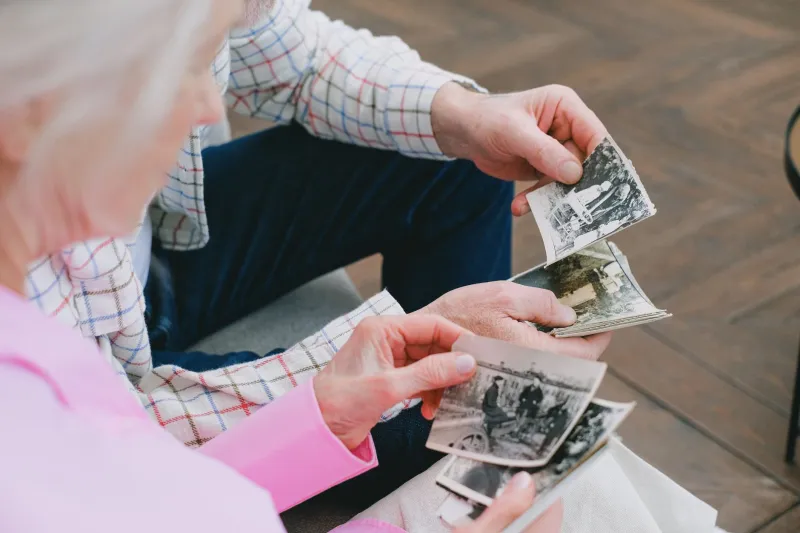
Kayla keeps a photo of her grandfather on her dresser. She looks at it every morning before she looks in the mirror.
"He's still in there somewhere," she says. "I'm sure of it."